
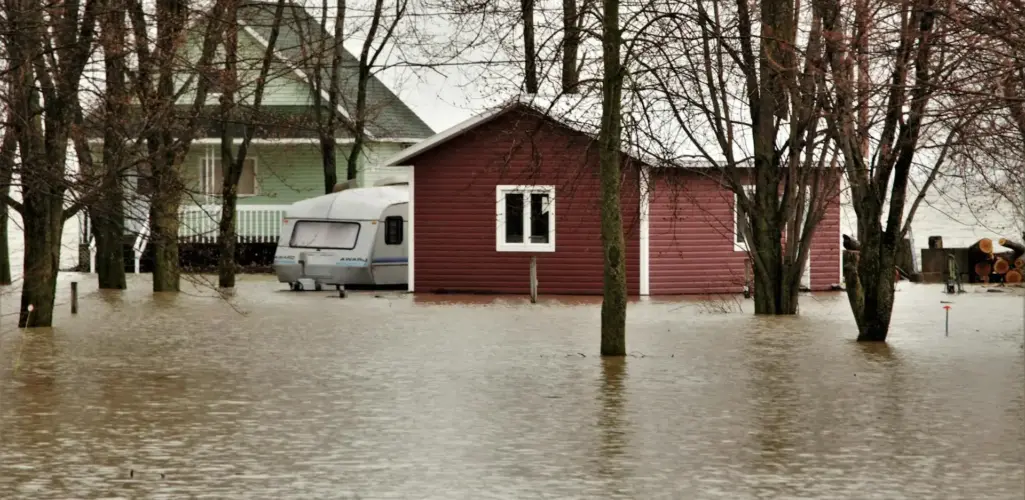
When your home gets wet, you might think, “damage is damage.” However, in the insurance world, where the water comes from determines whether you’re covered. Most homeowners are surprised to learn that standard policies usually exclude flood damage entirely. Understanding how flood damage can affect your home or business can help you see why flood insurance plays such a critical role in protecting your property and finances.
1. Flood Insurance
The Definition: A flood is water that comes from the ground up. It happens when dry land is suddenly covered by water.
- Causes: Heavy rain, overflowing rivers, storm surges, or rapid snowmelt.
- The Rule: If the water touched the ground before it entered your home, it is usually considered a flood.
- Coverage: You must buy this separately. Most people use the NFIP (government-backed) or a Private Flood policy.
2. Water Damage Coverage
The Definition: This covers water that comes from the top down or from inside the house.
- Causes: A burst pipe, a leaking roof, or a washing machine that overflows.
- The Rule: The incident must be “sudden and accidental.”
- Coverage: This is usually included in your standard homeowners policy.
Comparison at a Glance
| Feature | Water Damage Coverage | Flood Insurance |
| Included in Standard Policy? | Yes | No |
| Source of Water | Inside pipes, roof, appliances. | Rising lakes, heavy rain, runoff. |
| Primary Example | A pipe bursts in the kitchen. | A nearby creek overflows into your yard. |
| Maintenance Issues | Not covered (e.g., a slow leak for months). | Not covered (e.g., poor drainage neglect). |
Why You Might Need Both
Relying on just one type of coverage can leave a gap in your protection. This is especially important for business owners, since business insurance typically does not cover flood damage unless a separate flood policy is in place.
- Location Matters: Even if you aren’t in a “High-Risk” flood zone, 25% of all flood claims happen in low-to-moderate risk areas.
- Policy Limits: Standard policies have caps. For expensive homes, you may need a “Private Flood” policy to cover the full cost of your belongings.
- The “Grey Area”: If a hurricane blows your roof off (Water Damage) and then the street floods into your basement (Flood), having both policies prevents insurance companies from arguing over who pays.
How to Lower Your Risk
- Check Your Zone: Know your local flood risk level.
- Clear Your Gutters: Ensure water moves away from your foundation.
- Install a Sump Pump: This helps remove water that seeps into your basement.
- Review Your Policy: Check if you have “Sewer Backup” coverage—this is often a separate add-on!
Quiz: Do You Need Flood Insurance?
Answer “Yes” or “No” to the following questions:
- Do you live in an area that gets heavy rain or quick snowmelt?
- Is your home located near a body of water, even a small creek or drainage pond?
- Does your yard ever have standing water after a thunderstorm?
- Is your home at the bottom of a hill or in a low-lying spot?
- Could you afford to pay $25,000+ out of pocket to repair your home after a flood?
Results:
- If you answered “YES” to any of questions 1–4: You are at risk. Just one inch of water can cause over $25,000 in damage.
- If you answered “NO” to question 5: You definitely need a flood policy. It is a small monthly investment to prevent a massive financial loss.
Why the Waiting Period Matters
Flood insurance is not instant coverage.
- 30-Day Waiting Period: Most NFIP policies take 30 days to go into effect.
- Private Flood Options: Some private insurers offer shorter waiting periods (usually 10–14 days), but you still can’t buy coverage the day a hurricane is named.
Pro Tip:
If you’re buying a new home and flood insurance is required for your mortgage, the 30-day waiting period is often waived.
Don’t wait for a storm to find out you’re unprotected.
Most flood policies have a 30-day waiting period before coverage begins. Call G&G Independent Insurance today to make sure your home, car, and business are fully protected.